
Do & Don't
Это содержимое пока не доступно на вашем языке.
Purpose
Section titled “Purpose”This chapter introduces no new rule. It consolidates the Do/Don’t guidance already established, separately, across this book’s own completed chapters (Logo & Mark, Color System, Typography, Imagery Principles, Iconography, Applications) and the character-specific rules Mascot Book owns — into one place a reader can scan without opening every chapter individually. Every item below names its real source; nothing here is decided for the first time in this file.
(This chapter doesn’t solve the broader “no rendered misuse/anti-example image” gap — no rendered misuse image exists anywhere in this project yet, for any rule — but it does put every existing prose rule in one place and shows the real “Do” images that do exist, so the gap is visible in one location instead of scattered across seven chapters.)
How to read this chapter
Section titled “How to read this chapter”Same status vocabulary as the rest of this book (see Brand Book index): CANON (settled, sourced), PROPOSED (drafted, evidence-backed, not yet owner-confirmed), OPEN (no source exists — not filled in here). A rule can be CANON as a policy while the specific value it governs is still PROPOSED (color is the clearest case below) — the two are tracked separately, not conflated.
A note on the word “CANON” itself: a settled rule is tagged CANON below whenever its source states it as plain, settled fact — whether or not that source happens to use the literal word “CANON” for that specific sentence. This is consistent with how the term is used across this Brand Book generally, not a stricter or looser standard applied only here. Checked directly, chapter by chapter: logo.md’s Rule/Don’t never uses the word at all. Mascot Book’s Allowed usage section doesn’t either; its Prohibited usage section does use the word twice, but only inside one bullet about lore-fact status (ship name/accident cause), not the bullets this chapter cites for the headline Do/Don’t. Color’s actual “do not invent new hex codes” sentence doesn’t use the word, though the word does appear elsewhere in that same file section on an unrelated point (whether to formally adopt specific hex numbers). Where a source’s own wording is worth quoting directly (Imagery’s render-style rule is the clearest case below), that’s flagged inline — it isn’t a sign the other CANON tags in this chapter are less rigorous, only that this one source happens to say so explicitly.
Logo & Mark
Section titled “Logo & Mark”Do: use the mascot’s own canonical silhouette as the sole visual mark, in any context. — CANON. (Source: logo.md §Rule.)
Don’t:
- Commission or design a separate logo, wordmark, or symbol as an alternative to the mascot.
- Alter the base design without approval, or present it in a distorted or unattractive rendering.
- Alter the mask, ears, tail, or silhouette proportions in any presentation of the mark.
CANON. (Source: logo.md §Don’t, citing Mascot Book — Usage.)
Real visual example (Do): the same image logo.md embeds for this purpose.

Illustrative, not an approved canonical reference — see logo.md §Example for the full caveat (a known pink-bow/rank-glyph deviation on this specific image). Registered as BRAND-A05 in asset-registry.md.
Real visual example (Don’t): does not exist. No rendered misuse image (a distorted/stretched mark with a violation indicator) has been produced for this or any other rule in this book — a real, disclosed gap (BRAND-RULE-01, tests PARTIAL), not filled here with a fabricated one.
Do: use the tiered palette — Core (Cyan/Teal #12CFE4), Base (Pearl-white #E7E4E7), Accent (Pink #E1599C). — the direction (which three tones) is CANON; the specific measured hex values are PROPOSED, pending a quick owner confirmation, not a creative decision. (Source: color.md §Use.)
Don’t:
- Invent new hex codes beyond the measured values.
- Use
tokens.json’s site-UI values as a substitute for the mascot’s own costume palette.
CANON (procedural rule — this holds regardless of the PROPOSED/CANON status of the specific hex values above). (Source: color.md §Not yet determined.)
Real visual example (Do): the same swatch image color.md embeds.
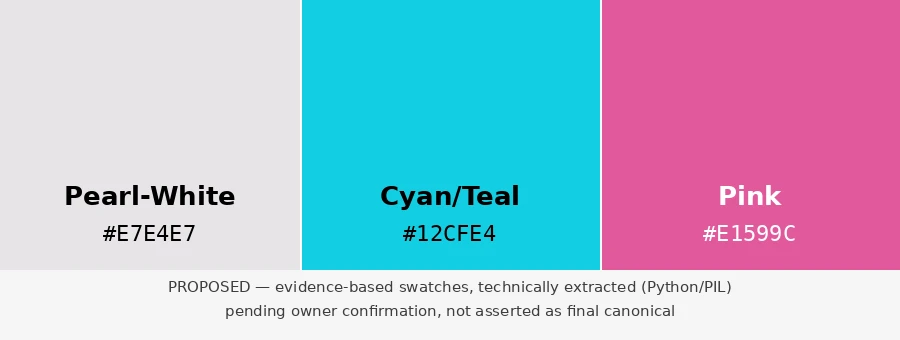
Registered as BRAND-A01 in asset-registry.md — reused here, not regenerated; see that registry’s note on its second placement.
Real visual example (Don’t): does not exist — no off-palette misuse render has been produced.
Typography
Section titled “Typography”Do: nothing exists to show here yet — no typeface is approved for SOLMAMY’s brand identity (OPEN, real gap, no invented placeholder shown as settled). One narrower, genuinely CANON exception: the wordmark (“SOLMAMY”) is always rendered fused, two-toned — “SOL” in pink, “MAMY” in cyan — never wrapped or stacked. (Source: Story & Universe Book’s Lunaris Insignia System wordmark typography rule.)
Don’t:
- Invent a typeface, size, or weight to fill the gap, anywhere, in any document.
- Adopt
tokens.json’s or the V1 brief’s typography values for SOLMAMY’s brand identity — those describe SOLMEME’s own site, a separate entity. - Treat this documentation’s own current markdown-viewer rendering as an implicit brand choice.
CANON (procedural rule). (Source: typography.md §Don’t.)
Real visual example: none — no typeface exists to specimen, and no rendered example of the wordmark’s two-tone rule has been produced as a standalone image (it is currently only demonstrated inline, in text form, in typography.md, and pictorially wherever the wordmark itself appears in a full character image such as the Logo/Mascot example above).
Mascot (cited from Mascot Book, not re-derived)
Section titled “Mascot (cited from Mascot Book, not re-derived)”Mascot Book owns character-specific rules; this book cites, it does not restate them in full. Full lists: Mascot Book — Usage.
Do: depict Sol Mamy in her approved costume (R1, or approved secondary R2) for first-party SOLMAMY/SOLMEME context, with the Lunar Vault Module as her signature prop “at whatever state matches the relevant rank context.” — CANON.
Don’t (headline items only — see Mascot Book — Usage for the complete list):
- Alter the mask, ears, tail, or silhouette proportions.
- Present a sealed dome-visor helmet (superseded; the open-face hard-shell helmet is canonical).
- Reintroduce the retired treasure-chest prop (superseded by the Lunar Vault Module).
- Invent new family members, ship name, accident cause, or antagonist names beyond what Story & Universe Book has already authored — and specifically for the two that ARE already authored (ship name, accident cause), do not present them as CANON rather than PROPOSED.
- Use in political/adult/controversial content, to imply financial-gain promises, to advertise scam projects, or in hate speech/harassment/discrimination.
CANON. (Source: Mascot Book — Usage, Prohibited usage / Additional prohibited usage.)
Real Do/Don’t example (textual, already CANON, not invented here):
Do: “Sol Mamy, in her canonical R1 suit, standing beside the Lunar Vault Module at its Glowing state.” Don’t: “Sol Mamy, wearing a sealed astronaut dome helmet, guarding a treasure chest.” — both details contradict the canonical reference.
(Source: Mascot Book — Usage, Do/Don’t example — quoted verbatim, not paraphrased.)
Imagery
Section titled “Imagery”Do: when the mascot appears in an image, match her own established render style — semi-realistic, polished, detailed treatment (never flat-cartoon, never hand-drawn/sketch), house lighting (single source, top-left, ~45°). — CANON as a strong, sourced claim (the literal word “CANON” does not appear in the source itself — see imagery.md’s own disclosure). (Source: imagery.md §Rule, citing Mascot Book — Visual Identity.)
Don’t:
- Invent a photography or illustration style to fill the general (non-mascot) imagery gap.
- Promote any of the 67 production images to Brand-canonical status — they remain Mascot Book’s own working examples.
- Treat “no general imagery rule exists yet” as license to use any arbitrary imagery — the mascot-usage prohibitions above still apply.
CANON. (Source: imagery.md §Don’t.)
Real visual example (Do): the same image already used above for Logo & Mascot also demonstrates this rule’s treatment-style half (not its lighting-direction half — imagery.md discloses this caveat honestly; not repeated in full here). Registered as BRAND-A05 (this chapter) / BRAND-A03 (imagery.md) — same physical file, cited for a third distinct purpose, not re-embedded a third time in this chapter to avoid needless duplication of the same image.
Iconography / Graphic Devices
Section titled “Iconography / Graphic Devices”Do: the Status Crest — three stacked chevrons, apex up, blue-to-cyan/indigo gradient glow, at eight fixed costume locations (corrected 2026-09-03, twice: count raised from seven to eight, then restated as the real unified count rather than an additive “seven plus one” framing; color word corrected to match Mascot Book’s own exact wording) — is Sol Mamy’s own real icon. — CANON. (Source: Mascot Book — Visual Identity, cited in imagery.md §Iconography.)
Don’t:
- Treat the Status Crest as free-standing brand iconography beyond what Mascot Book documents.
- Invent an icon set, icon grid, or icon-usage rule to fill the gap.
- Adopt the separate SOLMEME site’s real Lucide/badge icon system for SOLMAMY.
- Promote the legacy docs-site favicon (purple glow, book) to canonical status.
CANON. (Source: imagery.md §Iconography, §Don’t. Note: “SOURCE-DERIVED” is not a tag imagery.md itself uses for these items — corrected here to avoid implying a specific source label that doesn’t exist; each item traces to a real fact stated in that section, per the house convention noted above.)
Graphic Devices: no rule exists for SOLMAMY specifically — a real source system exists for the separate SOLMEME site (disclosed, not adopted; see imagery.md §Graphic Devices) — nothing is shown here as a SOLMAMY Do or Don’t, because none exists. OPEN.
Real visual example (Do): the Status Crest shown in its real costume context.
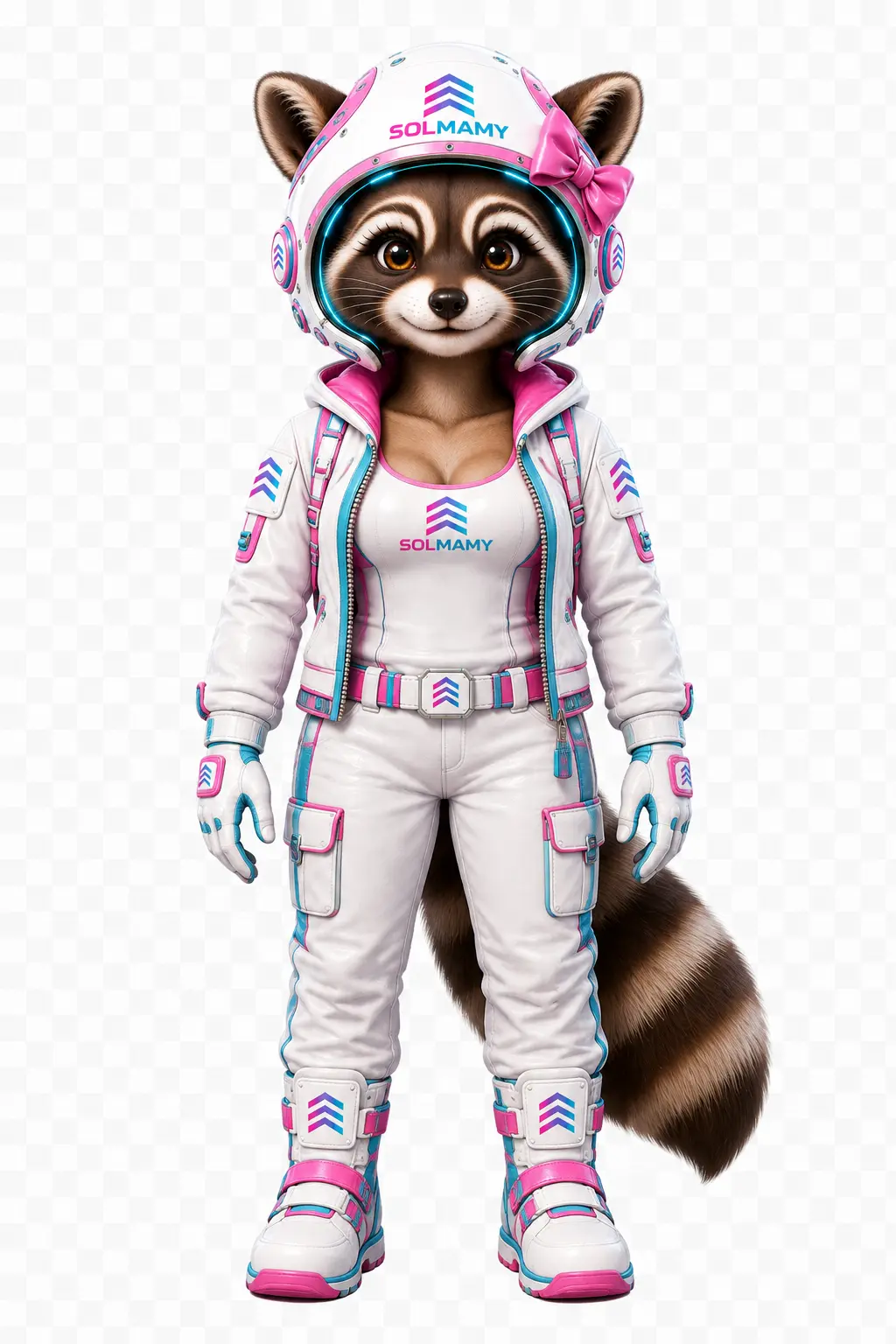
Registered as BRAND-A06 in asset-registry.md.
Applications
Section titled “Applications”Do: any new channel or product surface starts from this book’s canonical facts, not a fresh interpretation of the brand. — CANON (structural rule). (Source: applications.md §Use.)
Don’t: let a channel-specific document (Media, Game, Talking-Head) introduce a brand fact — a color, a tagline, a voice trait — that doesn’t already exist in this book. — CANON. (Source: applications.md §Do not use.)
Per-format maturity (Web, Social, Avatar, Community/event, Merch/print real; Mobile, Presentation, Partner/press, Campaign, Documents open; UI marked NOT APPLICABLE to this book — it’s community.solme.me’s own surface) is not repeated in full here — see applications.md’s own table, the source of truth for that breakdown.
Real visual example: none — no rendered application mockup exists for any format yet, per applications.md’s own disclosure.
What this chapter does not cover
Section titled “What this chapter does not cover”- Voice & Tone / Messaging Do/Don’t — visual areas only in this chapter. Brand Book’s own Usage Rules chapter already carries a Do/Don’t pair for institutional voice — not duplicated here. Its two halves carry different real status: the “Don’t” half (not implying a live product that doesn’t exist) is genuinely Canonical, per Foundation — Status; the “Do” half (using the institutional voice register) is Proposed, SOURCE-DERIVED, pending final owner approval — not yet formally Canonical, per Voice & Tone’s and Foundation’s own current tags.
- No proposal anywhere in this book is promoted to a settled rule by appearing in this consolidation — every status tag above matches its source chapter’s own current status, unchanged.
Part of the SOLMEME Brand Documentation System. Content status (Canonical/Proposed/Open/etc.) is this book’s own axis; ownership/rights are separate — see OWNERSHIP_AUTHORITY.md at the documentation system’s root.